
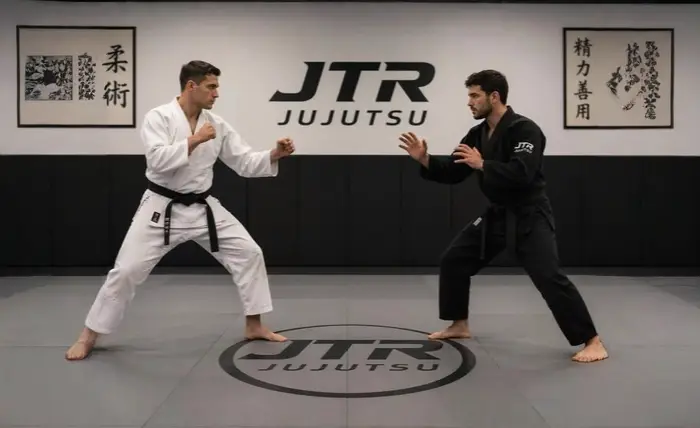
When people begin exploring martial arts, two names often come up early: Jujutsu and Karate. Both are rooted in Japanese tradition. Both build discipline, confidence, and physical skill. But they approach self-defense in fundamentally different ways. If you are deciding between the two, it helps to understand not just how they differ but how each prepares you for real-world situations. Let’s break it down.
Understanding the Techniques
Jujutsu
Jujutsu is centered on control, leverage, and close-range defense. Instead of meeting force with force, it teaches you how to redirect an opponent’s energy and use it against them.
Core elements include:
- joint locks
- throws and takedowns
- pins and restraints
- balance disruption
- defensive movement in close quarters
Because it relies on positioning and timing rather than brute strength, Jujutsu allows a smaller individual to effectively manage a larger or more aggressive opponent. This makes it especially practical for real-world encounters, where situations often involve grabbing, pushing, or being pulled off balance.
Karate
Karate focuses on striking, distance, and precision. It develops the ability to generate force quickly and deliver decisive techniques.
Core elements include:
- punches and kicks
- knee and elbow strikes
- blocking and defensive positioning
- footwork and distance control
Training typically includes fundamentals, forms (kata), and controlled sparring. This structure builds discipline, coordination, and sharp execution. Karate excels at teaching how to stop an attacker before they close the distance, using speed and well-timed strikes.
Self-Defense in Real Situations
Real-world self-defense is rarely clean or predictable. It often shifts quickly between distance and close contact.
Jujutsu is highly effective when:
- an attacker grabs or holds you
- the situation becomes entangled or off-balance
- the fight moves into close quarters or the ground
Karate is highly effective when:
- you have space to move
- you need to strike and disengage quickly
- you want to prevent the attacker from closing distance
Each art solves a different part of the same problem.
Why They Work Better Together
Relying on only one range of combat can leave gaps. A confrontation may begin standing, transition into grappling, and become unpredictable in seconds. Training both approaches creates a more complete skill set.
Karate develops:
- speed and reaction time
- striking power
- distance management
Jujutsu develops:
- control under pressure
- escape and restraint skills
- adaptability in close-range situations
Together, they build a martial artist who can respond effectively whether standing, clinched, or on the ground.
Which Should You Choose?
Your choice depends on your goals.
Choose Jujutsu if you want:
- practical close-range self-defense
- grappling, throws, and control
- techniques that rely on leverage over strength
Choose Karate if you want:
- strong striking ability
- speed, timing, and precision
- a structured training system with forms and sparring
Choose a combination of both if your goal is versatility and real-world readiness across multiple scenarios. JTR Jujutsu combat style system is a hybrid style that incorporates the striking techniques found in Karate blended with the contact and control elements of Jujutsu.
Final Thoughts
Jujutsu and Karate are not competing systems they are different solutions to the same challenge. Jujutsu teaches how to control and neutralize force at close range. Karate teaches how to strike, create space, and act decisively. The most important factor is not which style you choose, but how consistently you train and how well your training prepares you for real situations. A well-rounded martial artist is not defined by a single method, but by the ability to adapt when it matters most. Be sure to check out JTR Jujutsu International in Washington DC and see why you will get the most practical combo for real self-defense skills.